Breakthrough MULTICARE Study: The First Ever Resilience Readiness Levels for Buildings
Partners of the MULTICARE consortium have developed a revolutionary tool to assess building resilience against multiple climate-related hazards.
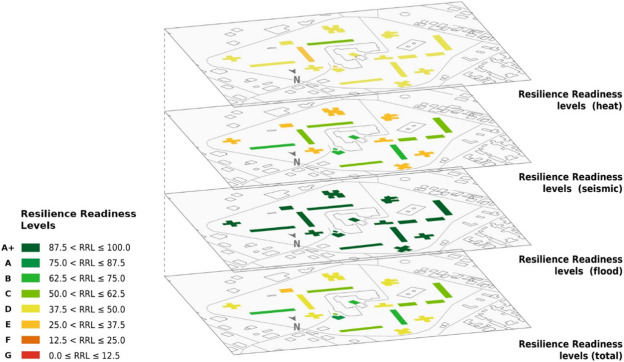
Can your building withstand heatwaves, floods, and earthquakes? Until now, no one could answer that definitively. A team of 18 researchers from the MULTICARE consortium, funded by Horizon Europe, has published a groundbreaking paper establishing Resilience Readiness Levels (RRL) for buildings — an eight-class rating system from F to A+, akin to energy performance labels.
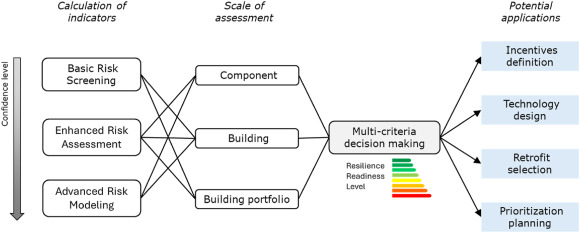
This pioneering approach evaluates four critical dimensions — structural integrity, social impact, economic cost, and environmental footprint — across single-hazard and multi-hazard scenarios including heat, seismic activity, wind, and flooding.
Highlights: Key results contributing to MULTICARE deliverables
- F-to-A+ rating: eight grades (F worst – A+ best) for instant resilience insight.
- Holistic multi-domain indicators: structural, social, economic, environmental.
- Hybrid AHP-TOPSIS methodology for weighted ranking vs. ideal profile.
- Normalization of metrics: common scale across diverse units.
What did the team achieve?
They delivered the world’s first comprehensive building-resilience rating system that replaces guesswork with scientific rigor and enables like-for-like comparisons across buildings and hazards.
Who drove this breakthrough?
- Simona Bianchi (TU Delft) – Conceptualization, methodology, supervision
- Michele Matteoni (University of Naples Federico II) – Methodology, visualization
- Kyujin Kim (TU Delft) – Research methodology
- Anna Maria Koniari (TU Delft) – Data analysis, visualization
- Francesco Petrini & Stefano Pampanin (University of Naples Federico II) – Supervision, review/editing
- Jonathan Ciurlanti & Michele Palmieri (EUCENTRE) – Validation
- Mauro Overend (University of Cambridge) – Review and validation
- Alessandra Luna-Navarro (TU Delft) – Methodological supervision
- Romulus Costache & Nicu Ciobotaru (Technical University of Civil Engineering Bucharest) – Indicator development
- Hamidreza Shahriari, Divyae Mittal, Evdokia Stavridou (AMS Institute) – Review and validation
- Anna Silva & Zhikai Peng (TU Delft & AMS Institute) – Data analysis and review
Major innovations
- F–A+ rating: instant grasp of building resilience levels.
- Holistic indicators across structure, social, economic, environmental.
- Hybrid AHP–TOPSIS methodology for objective ranking.
- Normalized metrics for unbiased aggregation.
Why is this a game-changer?
Previously, resilient building solutions were often neither cost-effective nor eco-friendly, and rarely addressed multiple hazards simultaneously due to the lack of a unified resilience framework.
Consequences of that gap included:
- Ill-informed investment choices
- Sub-optimal technical solutions
- Inability to compare resilience claims across buildings
Benefits of the new system:
- Informed design & retrofit: compare resilience levels early in design/retrofit.
- Priority setting: cities can identify which buildings need immediate upgrades under multi-hazard scenarios.
- Contextual adaptation: weights can be tuned to local priorities (e.g., floods NL, seismic IT, heat ES).
- Policy integration: enables resilience-based incentives and standards.
MULTICARE: An innovation ecosystem
This study exemplifies MULTICARE’s mission to create future-proof, sustainable, user-centered built environments. MULTICARE, coordinated by TU Delft and comprising 21 partners across six European countries, develops:
- Plug-&-play resilient, low-carbon technologies for easy integration into existing buildings.
- Multi-scale digital tools for resilience assessment and management, from individual buildings to entire districts.
- Real-world demonstrations in three pilot buildings and four urban districts under diverse climatic and geological conditions.
- User-driven co-creation with residents, facility managers, and local authorities.
Real-world case studies
Amsterdam: Six building archetypes were evaluated for heatwave resilience using energy simulations and historical heat data. Scores ranged from B to A, influenced by construction era, materials, and building compactness. Sensitivity analysis confirmed that weight choices markedly affect resilience scores.
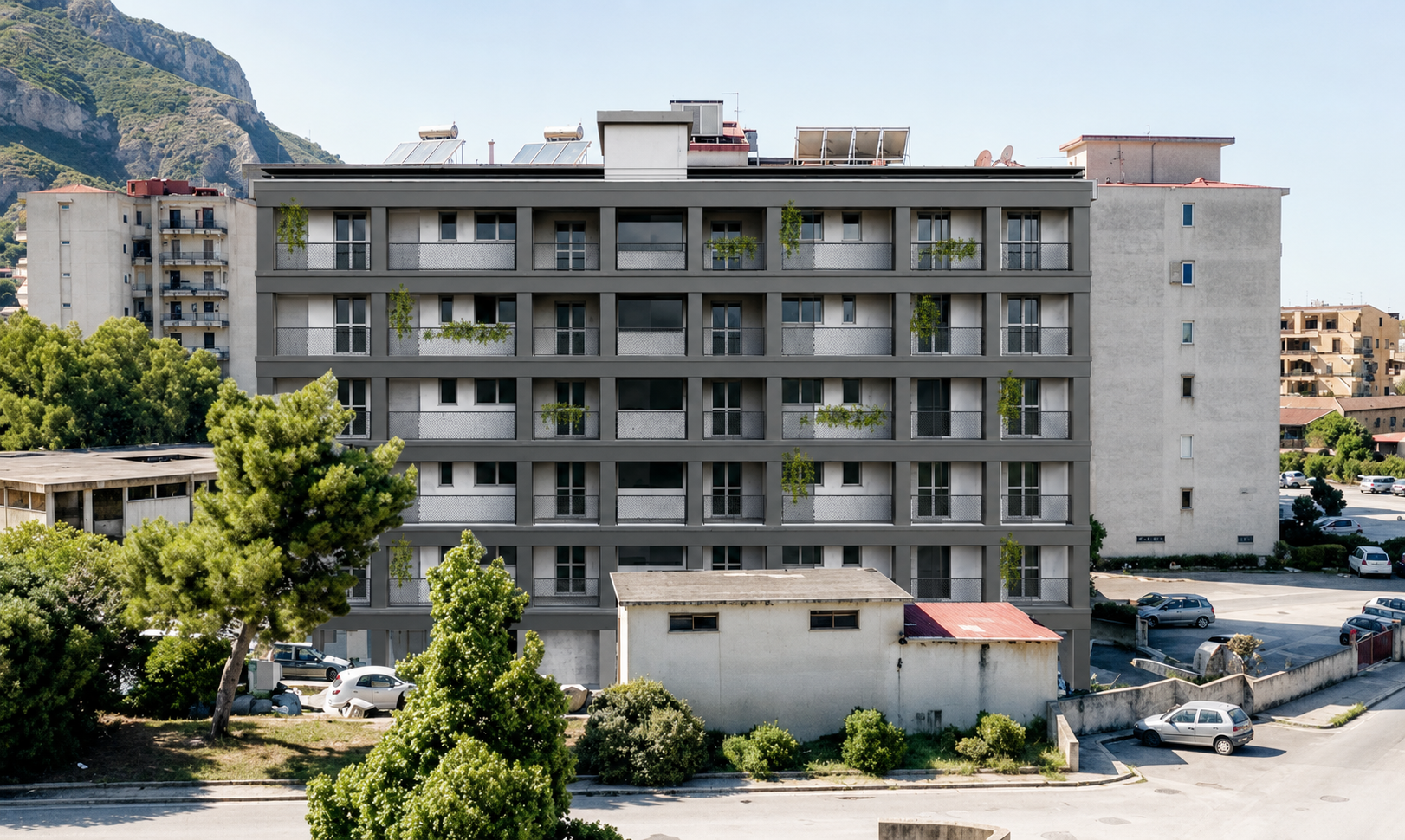
Acerra, Italy: Nineteen residential buildings were assessed for heat, seismic, flood, and wind hazards.
- Heat resilience: D–E
- Seismic resilience: B–E, depending on height and seismic intensity
- Flood resilience: High, due to low flood risk
- Wind impact: Negligible for studied structures
- Key insight: Low-rise buildings generally exhibited higher multi-hazard resilience.
Sensitivity testing revealed that varying hazard priorities significantly shifts building rankings, underscoring the need for context-specific weighting.
Future outlook
- Hazard interdependency modelling for cascading effects.
- AI-driven resilience (neural networks) to predict nonlinear relationships and failures.
- Scaling to entire urban areas and infrastructure networks.
- IoT integration for real-time monitoring and continuous rating updates.
Full paper: “Resilience Readiness Levels for buildings: Establishing multi-hazard resilience metrics and rating systems.” International Journal of Disaster Risk Reduction.
Funded by the European Union’s Horizon Europe research & innovation programme (Grant Agreement no. 101123467).
Most read