
Amsterdam, Netherlands
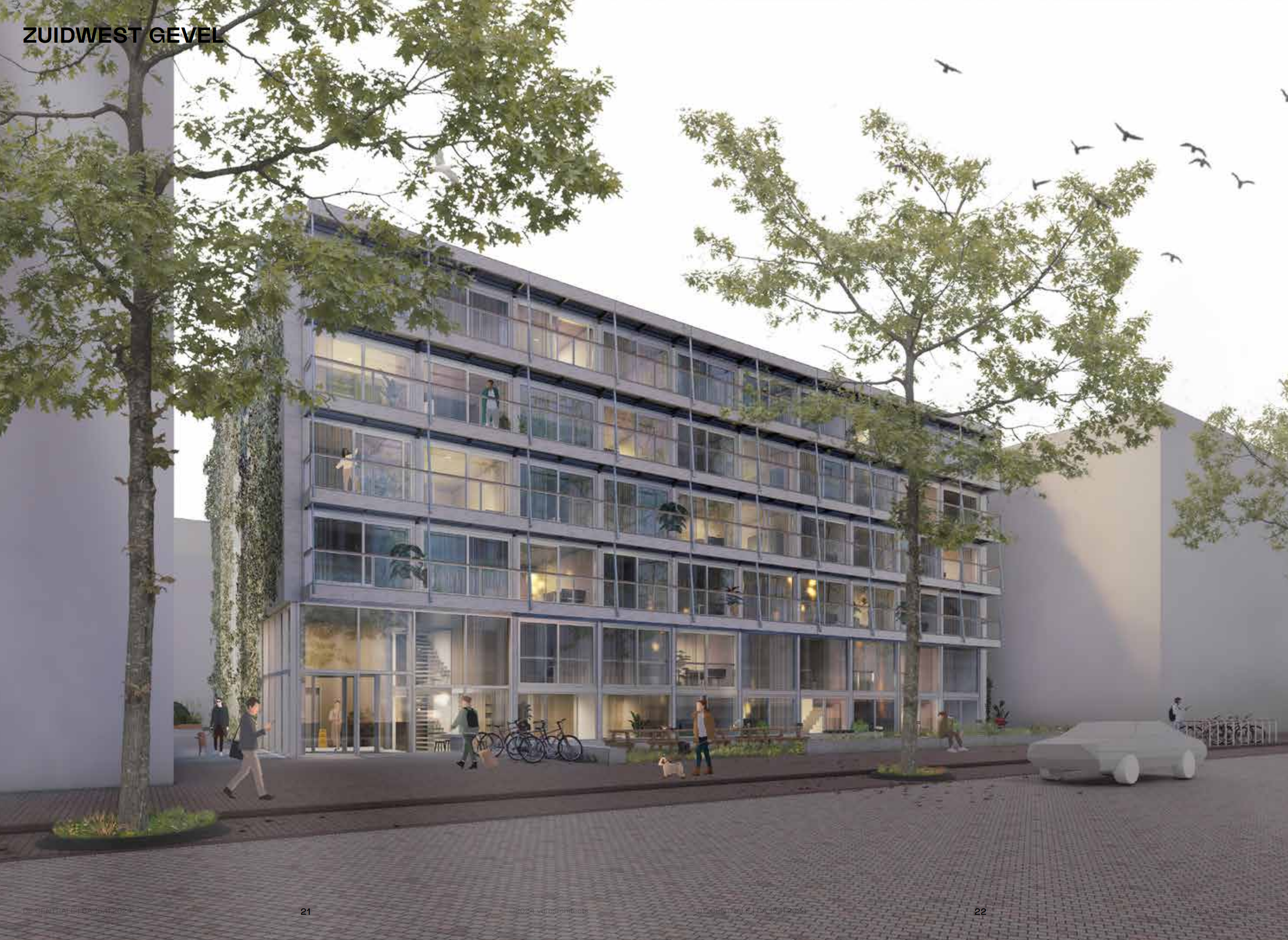
Amsterdam Pilot Site – Modular and Circular Residential Building
Building Overview
The Amsterdam pilot site at Maria Austriastraat 961 is a multistorey reinforced concrete residential building designed to demonstrate sustainable, modular and circular construction principles. The building has a rectangular footprint of 33m x 22m (726 m²) and consists of six storeys, each 2.7m high. It is divided into compact 30 m² apartments for short stays ranging from 5 days to 6 months.
Structure and Materials
- Modular steel system with demountable main structure
- Repurposed existing foundation and basement
- Façade combining bio-based timber panels, balconies and integrated sunshades (south)
- Green roofs and a west-facing bio-based façade with integrated greenery systems
Sustainability Features
- Fully bio-based façade materials
- Ease of disassembly and reuse (reversible construction)
- Wall thickness < 30 cm
- Zero operational carbon
- Vertical greenery systems
- Integrated energy production in façade
- Phase-change drywall system to enhance thermal resilience
The modular and flexible design ensures long-term adaptability, allowing changes in layout and functionality to meet evolving user needs and lifestyles.
MULTICARE Intervention
The project will implement a prefabricated plug-and-play façade on the west-facing side of the building, covering the top two floors. The façade integrates:
- Reversible construction for circularity
- Embedded sensor network for monitoring comfort, microclimate and structural integrity
- Energy generation system combined with green façade technologies and phase-change materials
- Permanent and temporary environmental sensors, including ibuttons, to measure temperature and humidity in the loadbearing structure and adjacent roof
Replication Potential
This type of stacked residential housing is typical in the Amsterdam Metropolitan Area, offering high replication potential at local, national and European levels. The façade system is designed to be compatible with both conventional and timber construction.
By replacing conventional aluminium façade panels with bio-based alternatives, approx. 8.5 tons of CO₂ can be saved per 100 m² – equivalent to the annual carbon absorption of 350 mature trees or emissions from flying 40,000 km.
Regional and national policies reinforce this potential:
- 32 municipalities aim to build 20% of new housing with timber or bio-based materials
- 65% of new buildings up to 10 storeys must use timber or bio-based systems
The pilot contributes to scaling sustainable, climate-resilient housing in line with European climate neutrality goals.
Virtual Demonstration
In addition to the physical demo, a virtual demonstration covers Amsterdam city centre, including Maria Austriastraat and Cruquiusweg. It compiles data on energy performance, climate resilience (urban heat island effect, indoor comfort) and circularity (embodied carbon of interventions).
A digital twin will be developed to estimate energy demand, comfort, carbon footprint and resilience under current and future climate conditions. This feeds into a parametric design tool to test retrofitting and material scenarios, calibrated with data from the physical demo.
Replication potential extends across all Dutch municipalities and historic European cities facing similar climate hazards, providing planners with integrated tools for sustainable urban retrofitting.